
Loading...

Loading...
 Bitcoin Plunge Below $27,000 Drives Investors Into Fear, Will Rebound Occur?Data shows the Bitcoin drop below the $27,000 level has made most investors fearful for the first time this month.
Bitcoin Fear & Greed Index Is Pointing At “Fear” Right Now
The “fear and greed index” is an indicator that tells us about the general sentiment among investors in the Bitcoin and broader cryptocurrency market. Alternativecreated the metric, and according to the website, it’s based on these factors: volatility, trading volume, social media sentiment, market cap dominance, and Google Trends data.
The indicator uses a numeric scale from zero to hundred to represent the sentiment. When the index has a value greater than 54, it means that the average investor is greedy right now, while it being under 46 implies a fearful mentality is dominant.
Related Reading: Bitcoin Finds Rejection At This Historical Line, Bear Market Back On?
The region between these two thresholds naturally signifies a neutral sentiment among the holders. Until today, the sector had been stuck inside this region since the last couple of days of September, as the investors had been split about the trajectory of Bitcoin.
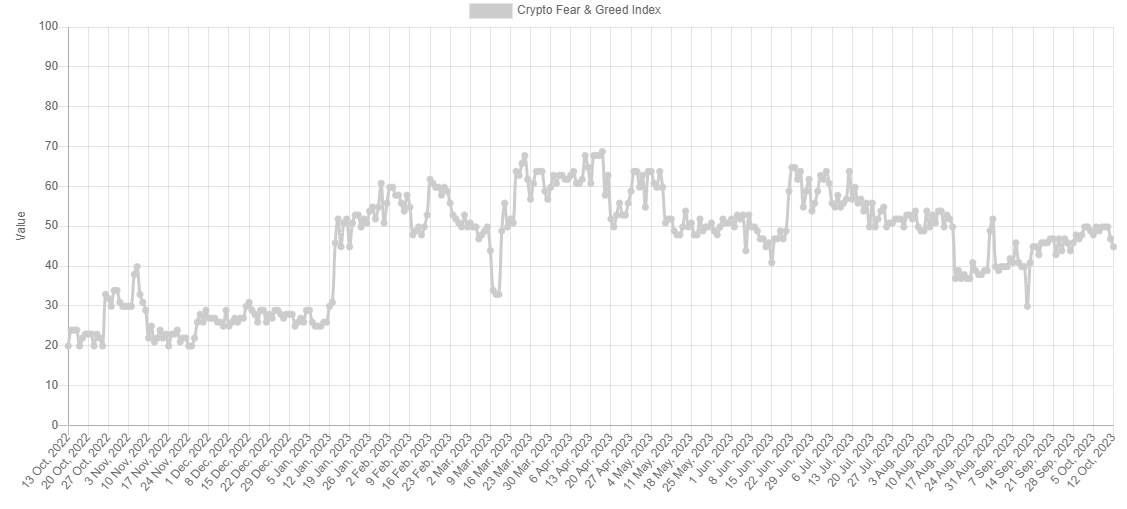
The chart below shows that the market sentiment has worsened with the latest drop in the cryptocurrency’s price below the $27,000 level.
It looks like the value of the metric has registered some decline in recent days | Source: Alternative
After this latest drop in sentiment, the fear and greed index has hit a value of 45, meaning that investor sentiment has just entered the fear region.
The value of the metric seems to be 45 right now | Source: Alternative
Historically, the market has tended to move in a way that’s opposite to what the majority of the investors believe. The likelihood of such a contrary move happening increases as this imbalance in the sentiment rises.
While the holders are leaning towards one side (fear), the imbalance is small, as the fear and greed index is barely inside the territory. As such, the probability of a rebound would be pretty high right now (at least based on the sentiment).
Besides the core sentiments discussed before, there are also two special zones, called “extreme fear” (at or below values of 25) and “extreme greed” (at or above values of 75).
These regions are where the cryptocurrency has often turned around in the past. Naturally, bottoms have occurred in the former zone, while tops have formed in the latter area.
Related Reading: Bitcoin Could See A 50% Rise Based On This, Analyst Explains
If the Bitcoin fear and greed index continues declining in the coming days and reaches values near the extreme fear region, a bounce could become a real possibility.
For now, one sign pointing to the chances of a rebound may be that the large investors have been buying recently, as an analyst on X pointed out.
The BTC sharks have increased their holdings recently | Source: @ali_charts on X
Since the start of October, Bitcoin investors holding between 100 and 1,000 coins have purchased a combined 20,000 BTC worth around $533.6 million at the current exchange rate.
BTC Price
At the time of writing, Bitcoin is trading at around $26,700, down almost 5% in the past week.
BTC has experienced some downtrend recently | Source: BTCUSD on TradingView
Featured image from Bastian Riccardi on Unsplash.com, charts from TradingView.com, Santiment.net
Tags:bitcoinBitcoin fearBitcoin Fear & Greed IndexBitcoin Reboundbtcbtcusd
Bitcoin Plunge Below $27,000 Drives Investors Into Fear, Will Rebound Occur?Data shows the Bitcoin drop below the $27,000 level has made most investors fearful for the first time this month.
Bitcoin Fear & Greed Index Is Pointing At “Fear” Right Now
The “fear and greed index” is an indicator that tells us about the general sentiment among investors in the Bitcoin and broader cryptocurrency market. Alternativecreated the metric, and according to the website, it’s based on these factors: volatility, trading volume, social media sentiment, market cap dominance, and Google Trends data.
The indicator uses a numeric scale from zero to hundred to represent the sentiment. When the index has a value greater than 54, it means that the average investor is greedy right now, while it being under 46 implies a fearful mentality is dominant.
Related Reading: Bitcoin Finds Rejection At This Historical Line, Bear Market Back On?
The region between these two thresholds naturally signifies a neutral sentiment among the holders. Until today, the sector had been stuck inside this region since the last couple of days of September, as the investors had been split about the trajectory of Bitcoin.
The chart below shows that the market sentiment has worsened with the latest drop in the cryptocurrency’s price below the $27,000 level.
It looks like the value of the metric has registered some decline in recent days | Source: Alternative
After this latest drop in sentiment, the fear and greed index has hit a value of 45, meaning that investor sentiment has just entered the fear region.
The value of the metric seems to be 45 right now | Source: Alternative
Historically, the market has tended to move in a way that’s opposite to what the majority of the investors believe. The likelihood of such a contrary move happening increases as this imbalance in the sentiment rises.
While the holders are leaning towards one side (fear), the imbalance is small, as the fear and greed index is barely inside the territory. As such, the probability of a rebound would be pretty high right now (at least based on the sentiment).
Besides the core sentiments discussed before, there are also two special zones, called “extreme fear” (at or below values of 25) and “extreme greed” (at or above values of 75).
These regions are where the cryptocurrency has often turned around in the past. Naturally, bottoms have occurred in the former zone, while tops have formed in the latter area.
Related Reading: Bitcoin Could See A 50% Rise Based On This, Analyst Explains
If the Bitcoin fear and greed index continues declining in the coming days and reaches values near the extreme fear region, a bounce could become a real possibility.
For now, one sign pointing to the chances of a rebound may be that the large investors have been buying recently, as an analyst on X pointed out.
The BTC sharks have increased their holdings recently | Source: @ali_charts on X
Since the start of October, Bitcoin investors holding between 100 and 1,000 coins have purchased a combined 20,000 BTC worth around $533.6 million at the current exchange rate.
BTC Price
At the time of writing, Bitcoin is trading at around $26,700, down almost 5% in the past week.
BTC has experienced some downtrend recently | Source: BTCUSD on TradingView
Featured image from Bastian Riccardi on Unsplash.com, charts from TradingView.com, Santiment.net
Tags:bitcoinBitcoin fearBitcoin Fear & Greed IndexBitcoin Reboundbtcbtcusd Less than 50% of Hong Kong retail crypto investors aware of relevant regulations: SurveyHong Kong has allowed retail crypto trading since June.
Just 47% of retail crypto investors in Hong Kong are aware of the Virtual Asset Trading Platform Regulatory Regime, a piece of legislation that went into effect this June to protect the interests of retail investors in digital assets in the region.
That’s according to an Oct. 11 reportby the Investor and Financial Education Council (IFEC) of Hong Kong. In its survey, the IFEC noted that nearly 25% of Hong Kong adults ages 18–29 have invested in crypto within the past year, three times the demographic average and a significant increase over 2019, where just 3% of respondents in the said demographic reported investing in crypto.
Despite the improvement in adoption, most Hong Kongers said that their top investment preferences were stocks (96%), mutual funds and trusts (24%), followed by bonds (18%). Around three-quarters of overall respondents said the primary goal of investing in crypto was “short-term profits,” alongside “fear of missing out.” The survey featured 1,000 respondents between the ages of 18 and 69.
“Investors should understand the product characteristics and related risks before investing, in order to align their choices with their financial goals and risk tolerance level,” said IFEC general manager Dora Li in response to the results. Meanwhile, Eric Chui, head of the department of applied social sciences at PolyU, commented, “Virtual asset investors should think more deliberately and rationally. They should also build up their financial literacy and collect high-quality market informationto avoid the irrational investment behaviour and biases.”
Beginning in June, Hong Kong legalized retail crypto trading for licensed exchanges, to mixed results. During this time, the largest Ponzi scheme in Hong Kong history, the $166-million JPEX crypto exchange scandal, unraveled in the Special Administrative Region of China.
Magazine: 3AC fugitives in disarray as OPNX faces new perilIs a Shiba Inu (SHIB) Crash Incoming? Investors Transferred Over 1 Trillion Tokens Into Crypto ExchangesTL;DR
Over 1 trillion SHIB assets shifted to exchanges, possibly indicating selling pressure as the price dropped.
Some analysts, including trader $SHIB KNIGHT, believe SHIB might rally soon, predicting a potential 8-month high.
Shiba Inu’s burning program and the development of Shibarium provide bullish momentum for the coin’s future.
What’s Next for SHIB?
According to CryptoQuant data, Shiba Inu investors have movedover 1 trillion assets into cryptocurrency exchanges in the past few days. The rapid shift started on October 8, a day before SHIB’s price fell significantly (in resonance with the entire digital asset market).
The total amount of tokens stored at cryptocurrency marketplaces peaked on October 9 at over 169.7 trillion (equaling around $1.1 billion). Shortly after, the figure slightly decreased to approximately 169.3 trillion.
Shifting from self-custody methods to crypto platforms is usually considered a bearish sign since the growing exchange supply could indicate selling pressure. SHIB has been down over 5% on a weekly basis and is far away from its latest mini-bull run recorded in August this year.
This Could be the Bottom
Contrary to the aforementioned pessimistic trend, some analysts have suggested that Shiba Inu’s price might have found the bottom, meaning it could start rallying in the following months. One proponent of that thesis is the popular cryptocurrency trader using the X (Twitter) handle $SHIB KNIGHT.
They recently assumedthat SHIB could spike to an 8-month high of $0.0003 since the asset remains above a critical support line.
The successful execution of Shiba Inu’s burning program and the development of the layer-2 blockchain solution Shibarium have also been presented as bullish elements. The network that aims to elevate the memecoin as a leader in its field has reachedseveral milestones in its short existence and keeps advancing. More information on Shibarium and its purposes can be found in the video below:
SPECIAL OFFER (Sponsored)Binance Free $100 (Exclusive): Use this linkto register and receive $100 free and 10% off fees on Binance Futures first month( terms).
PrimeXBT Special Offer: Use this linkto register & enter CRYPTOPOTATO50 code to receive up to $7,000 on your deposits.
Tags: Shiba InuShiba Inu (SHIB)XBTO Launches Game-Changing XBTO ProTrading (Powered by Stablehouse) to Empower Institutional InvestorsPress Release
XBTO, a comprehensive platform for digital assets management and tailored investment solutions, today, with its partner company Stablehouse Ltd., introduced XBTO ProTrading (PT). This is a state of the art platform designed specifically for institutions and qualified investors.
XBTO ProTrading (PT) addresses critical challenges faced by both qualified and institutional investors in the digital asset sector, offering advanced execution capabilities alongside unparalleled client asset protection and service. ProTrading marks the first major product release since XBTO's announcement of its pending acquisition of the digital asset custody & trading platform, Stablehouse, in August 2023. This partnership has enabled XBTO to rapidly expand its suite of services for institutional investors in digital assets.
One of the major issues faced by investors is inefficient execution, which can result in delayed trades and missed opportunities. XBTO ProTrading directly tackles this, optimizing trading processes with professional trading views, enhanced order support, and optimal liquidity via its Smart Order Router and XBTO’s comprehensive counterparty network.
Another prevalent concern revolves around the risks inherent to digital asset trading. Clients frequently express concerns about fund security and potential legal vulnerabilities. XBTO ProTrading prioritises the protection of funds, ensuring that clients don't have to worry about the security of their funds or potential legal vulnerabilities. By offering segregated client accounts that are auditable on the blockchain and providing comprehensive legal safeguards, XBTO shields customer assets frompotential creditor claims, instilling confidence and peace of mind among users. XBTO's commitment to top-tier security and legal compliance is showcased by its operation under the Bermuda Monetary Authority, demonstrating a proactive choice of a progressive jurisdiction.
This innovative product encompasses the XBTO Trader UI, and a ProTrading access account seamlessly hosted within the XBTO-Stablehouse Custody platform. The rollout will commence with early access on Oct. 9, followed by official general availability on Oct. 25.
Commenting on the launch was Javier Rodriguez-Alarcon, CCO, XBTO: "We believe in giving access to professional-grade trading services to institutional clients to facilitate an effective adoption of digital assets. With XBTO ProTrading, we're making it possible for qualified investors, regardless of their scale, to experience secure, efficient and high-touch trading that was previously accessible only to a segment of experts. Our priority is to offer confidence and safety while facilitating a seamless trading and custody experience."
The platform also offers high-touch service, providing a personalised trading experience. With features like a dedicated Relationship Manager, an OTC Trading Desk for customised order execution, and accessibility to an extensive network of top-tier liquidity providers, XBTO ProTrading ensures that users have the support and services needed for successful trading.
Javier concluded: “XBTO ProTrading offers a robust alternative to the current digital asset trading landscape, offering a holistic platform that enhances the trading experience and provides a unique value proposition for both qualified and institutional investors. Investors are encouraged to explore and register for the XBTO Pro Trading early access program, embracing a new era of secure, efficient and high-touch digital asset trading and custody."
Less than 50% of Hong Kong retail crypto investors aware of relevant regulations: SurveyHong Kong has allowed retail crypto trading since June.
Just 47% of retail crypto investors in Hong Kong are aware of the Virtual Asset Trading Platform Regulatory Regime, a piece of legislation that went into effect this June to protect the interests of retail investors in digital assets in the region.
That’s according to an Oct. 11 reportby the Investor and Financial Education Council (IFEC) of Hong Kong. In its survey, the IFEC noted that nearly 25% of Hong Kong adults ages 18–29 have invested in crypto within the past year, three times the demographic average and a significant increase over 2019, where just 3% of respondents in the said demographic reported investing in crypto.
Despite the improvement in adoption, most Hong Kongers said that their top investment preferences were stocks (96%), mutual funds and trusts (24%), followed by bonds (18%). Around three-quarters of overall respondents said the primary goal of investing in crypto was “short-term profits,” alongside “fear of missing out.” The survey featured 1,000 respondents between the ages of 18 and 69.
“Investors should understand the product characteristics and related risks before investing, in order to align their choices with their financial goals and risk tolerance level,” said IFEC general manager Dora Li in response to the results. Meanwhile, Eric Chui, head of the department of applied social sciences at PolyU, commented, “Virtual asset investors should think more deliberately and rationally. They should also build up their financial literacy and collect high-quality market informationto avoid the irrational investment behaviour and biases.”
Beginning in June, Hong Kong legalized retail crypto trading for licensed exchanges, to mixed results. During this time, the largest Ponzi scheme in Hong Kong history, the $166-million JPEX crypto exchange scandal, unraveled in the Special Administrative Region of China.
Magazine: 3AC fugitives in disarray as OPNX faces new perilIs a Shiba Inu (SHIB) Crash Incoming? Investors Transferred Over 1 Trillion Tokens Into Crypto ExchangesTL;DR
Over 1 trillion SHIB assets shifted to exchanges, possibly indicating selling pressure as the price dropped.
Some analysts, including trader $SHIB KNIGHT, believe SHIB might rally soon, predicting a potential 8-month high.
Shiba Inu’s burning program and the development of Shibarium provide bullish momentum for the coin’s future.
What’s Next for SHIB?
According to CryptoQuant data, Shiba Inu investors have movedover 1 trillion assets into cryptocurrency exchanges in the past few days. The rapid shift started on October 8, a day before SHIB’s price fell significantly (in resonance with the entire digital asset market).
The total amount of tokens stored at cryptocurrency marketplaces peaked on October 9 at over 169.7 trillion (equaling around $1.1 billion). Shortly after, the figure slightly decreased to approximately 169.3 trillion.
Shifting from self-custody methods to crypto platforms is usually considered a bearish sign since the growing exchange supply could indicate selling pressure. SHIB has been down over 5% on a weekly basis and is far away from its latest mini-bull run recorded in August this year.
This Could be the Bottom
Contrary to the aforementioned pessimistic trend, some analysts have suggested that Shiba Inu’s price might have found the bottom, meaning it could start rallying in the following months. One proponent of that thesis is the popular cryptocurrency trader using the X (Twitter) handle $SHIB KNIGHT.
They recently assumedthat SHIB could spike to an 8-month high of $0.0003 since the asset remains above a critical support line.
The successful execution of Shiba Inu’s burning program and the development of the layer-2 blockchain solution Shibarium have also been presented as bullish elements. The network that aims to elevate the memecoin as a leader in its field has reachedseveral milestones in its short existence and keeps advancing. More information on Shibarium and its purposes can be found in the video below:
SPECIAL OFFER (Sponsored)Binance Free $100 (Exclusive): Use this linkto register and receive $100 free and 10% off fees on Binance Futures first month( terms).
PrimeXBT Special Offer: Use this linkto register & enter CRYPTOPOTATO50 code to receive up to $7,000 on your deposits.
Tags: Shiba InuShiba Inu (SHIB)XBTO Launches Game-Changing XBTO ProTrading (Powered by Stablehouse) to Empower Institutional InvestorsPress Release
XBTO, a comprehensive platform for digital assets management and tailored investment solutions, today, with its partner company Stablehouse Ltd., introduced XBTO ProTrading (PT). This is a state of the art platform designed specifically for institutions and qualified investors.
XBTO ProTrading (PT) addresses critical challenges faced by both qualified and institutional investors in the digital asset sector, offering advanced execution capabilities alongside unparalleled client asset protection and service. ProTrading marks the first major product release since XBTO's announcement of its pending acquisition of the digital asset custody & trading platform, Stablehouse, in August 2023. This partnership has enabled XBTO to rapidly expand its suite of services for institutional investors in digital assets.
One of the major issues faced by investors is inefficient execution, which can result in delayed trades and missed opportunities. XBTO ProTrading directly tackles this, optimizing trading processes with professional trading views, enhanced order support, and optimal liquidity via its Smart Order Router and XBTO’s comprehensive counterparty network.
Another prevalent concern revolves around the risks inherent to digital asset trading. Clients frequently express concerns about fund security and potential legal vulnerabilities. XBTO ProTrading prioritises the protection of funds, ensuring that clients don't have to worry about the security of their funds or potential legal vulnerabilities. By offering segregated client accounts that are auditable on the blockchain and providing comprehensive legal safeguards, XBTO shields customer assets frompotential creditor claims, instilling confidence and peace of mind among users. XBTO's commitment to top-tier security and legal compliance is showcased by its operation under the Bermuda Monetary Authority, demonstrating a proactive choice of a progressive jurisdiction.
This innovative product encompasses the XBTO Trader UI, and a ProTrading access account seamlessly hosted within the XBTO-Stablehouse Custody platform. The rollout will commence with early access on Oct. 9, followed by official general availability on Oct. 25.
Commenting on the launch was Javier Rodriguez-Alarcon, CCO, XBTO: "We believe in giving access to professional-grade trading services to institutional clients to facilitate an effective adoption of digital assets. With XBTO ProTrading, we're making it possible for qualified investors, regardless of their scale, to experience secure, efficient and high-touch trading that was previously accessible only to a segment of experts. Our priority is to offer confidence and safety while facilitating a seamless trading and custody experience."
The platform also offers high-touch service, providing a personalised trading experience. With features like a dedicated Relationship Manager, an OTC Trading Desk for customised order execution, and accessibility to an extensive network of top-tier liquidity providers, XBTO ProTrading ensures that users have the support and services needed for successful trading.
Javier concluded: “XBTO ProTrading offers a robust alternative to the current digital asset trading landscape, offering a holistic platform that enhances the trading experience and provides a unique value proposition for both qualified and institutional investors. Investors are encouraged to explore and register for the XBTO Pro Trading early access program, embracing a new era of secure, efficient and high-touch digital asset trading and custody." Dark Side of Crypto ETF Approval: Unveiling the Hidden Risks and Challenges for Markets and InvestorsCryptocurrency exchange-traded funds (ETFs) have recently been trending as many companies seek approval to trade, stirring up a wave of enthusiasm and anticipation throughout the crypto community.
As financial vehicles that track the price of cryptocurrencies, these ETFs offer a novel and seemingly more accessible way for investors to enter the crypto market. However, amidst the euphoria and bullish outlooks, it is crucial to cast a discerning eye on the potential dark side of this development.
This article aims to shed light on the hidden risks and challenges that crypto ETFs present to both individual investors and the broader crypto market.
Centralization of Crypto Assets
Cryptocurrency exchanges come in various forms, with centralized exchanges, exemplified by platforms like FTX, being the most prevalent. Centralized exchanges retain control of their client’s private keys and typically mandate a Know Your Customer (KYC) process to deter unlawful activities.
In contrast, decentralized cryptocurrency exchanges operate on a decentralized, non-custodial blockchain system, facilitating direct peer-to-peer transactions. That eliminates the need for intermediaries, allowing users to bypass the KYC process. It is particularly significant for individuals living under repressive governments, offering them an opportunity to participate. Users also maintain full control over their private keys and assume sole responsibility for securing their funds, which can be staked to generate interest.
The cryptocurrency industry’s primary purpose is to provide these advantages, especially to unbanked individuals who lack access to traditional banking services. Conversely, ETFs are inherently centralized products, conflicting with the decentralized essence of Bitcoin and other cryptocurrencies. They do not incorporate the foundational benefits of cryptocurrencies, nor do they encourage new users to engage in the space.
Moreover, ETFs introduce the concept of “paper” Bitcoin, which represents BTC only on a theoretical level. Without the ability to withdraw the purportedly owned Bitcoin, the potential for crises similar to those witnessed with FTX becomes more plausible in the future. That poses a threat to the core principles of decentralization and trustless transactions that underpin Bitcoin.
Regulatory Risks
The regulatory landscape surrounding crypto ETFs presents a significant array of challenges and risks. The approval processfor these financial products is complex, creating an air of uncertainty for investors. Government bodies like the U.S. Securities and Exchange Commission (SEC) have been cautious in approving ETFs linked to Bitcoin and other cryptocurrencies. Their hesitance stems from concerns about potential fraud and manipulation within the underlying market.
Todd Rosenbluth, head of research at VettaFi, pointed out that the earlier expected government shutdown might further complicate matters for ETF applications seeking approval. He noted that with the SEC being potentially unable to review new ETFs, there could be room for launches to proceed.
The SEC has postponedits decision on whether to approve applications for spot Bitcoin ETFs to mid-October, highlights Reuters. Todd Sohn, ETF and technical strategist at Strategas Securities, noted that this delay only extends the ongoing deliberation surrounding spot Bitcoin ETFs. He suggested that both investors and issuers may already be growing impatientwith the process, so a shutdown only adds to the frustration. Analysts also cautioned that listed funds could face heightened volatility.
However, with the shutdown now avoided, a crypto enthusiast, Mike Dudas, wroteon X that he is looking forward to 6 Bitcoin ETF decisions by the SEC as they have no reason to postpone the decision anymore.
An earlier post on X by Eric Balchunas, a Bloomberg ETF analyst, notedthat Valkyrie has recently communicated that they will refrain from purchasing Ether futures until they become operational. Additionally, they have decided to sell the Ether futures they had previously acquired, possibly in an attempt to expedite the process. This move might be in response to pressure or warnings from the SEC.
Hector McNeil, co-CEO and founder of HANetf, emphasized that ETFs essentially act as pass-through vehicles. Therefore, any impact on the underlying markets will naturally have repercussions on the ETFs themselves.
Limited Profit Potential
The high price of a single Bitcoin has often made it a challenging investment for many individuals worldwide. That has led to a growing interest in finding alternative ways to invest in Bitcoin and mitigate the risks associated with directly purchasing the cryptocurrency.
One such alternative is a Bitcoin ETF, which allows investors to gain exposure to cryptocurrencies without the hassle of setting up a wallet or dealing with volatile exchanges. However, industry experts caution that Bitcoin ETFs are not without their risks, Gulf News highlights.
Brian Deshell, a UAE-based cryptocurrency trader and analyst, highlighted that while buying shares of a Bitcoin ETFprovides exposure to Bitcoin’s price movements, it may not necessarily fulfill all the desires of investors looking to access cryptocurrencies. He emphasized that investors should be confident that their money will be secure in a regulated product like a Bitcoin ETF. However, it hasn’t been proven to be an effective means to significantly grow one’s wealth in the crypto market, and progress in regulatory approvals has been limited.
Brody Dunn, an investment manager at a UAE-based asset advisory firm, noted that although a Bitcoin ETF isn’t a direct investment in cryptocurrency, it still carries risks due to its exposure to Bitcoin. He cautioned that individuals who assume that investing in Bitcoin ETFs will make it incredibly safe for them without conducting proper due diligence may face concerns.
Dunn acknowledged that the introduction of a Bitcoin ETF is positive for the overall Bitcoin and crypto market. However, he raised a concern that it may not necessarily benefit individual investors as much as it benefits institutional players. While an ETF may attract more institutional money into the market, the average investor may not experience the same level of benefit as intended.
Further SEC Delays on Crypto ETFs
Even though United States Representatives Mike Flood, Wiley Nickel, Tom Emmer, and Ritchie Torres have urged the Securities and Exchange Commission (SEC) to promptly greenlight the listing of spot Bitcoin (BTC) exchange-traded funds (ETFs), the agency has, once more, postponed its decision.
The SEC has extended its decision deadlines for spot Ether ETFs from VanEck and ARK 21Shares to Dec. 25 and Jan. 10, respectively. GlobalX will have to wait until Nov. 21 for the commission’s decision on their application. In addition, the SEC pushed back the decision dates for spot Bitcoin ETF applications from Invesco, Bitwise, and Valkyrie to mid-January.
These recent delays occurred two weeks earlier than the anticipated second deadline for many applicants, who had initially expected to receive feedback from the securities regulator between Oct. 16–19. The timing of the delays may be linked to the narrowly averted U.S. government shutdown, which could have disrupted various federal agencies, including financial regulators.
In response to the delay of its spot Bitcoin ETF, Bitwise Asset Management submitted an amended application, addressing the SEC’s concerns regarding the product. In this revised application, Bitwise engaged with what the SEC called “the ‘mixed’ or ‘inconclusive’ academic record” on the lead-lag relationship between BTC futures and spot markets.
Meanwhile, multiple Ethereum futures exchange-traded funds (ETFs) have commenced trading in the United States. On Monday morning, investment firms, including ProShares, VanEck, Bitwise, Valkyrie, Kelly, and Volshares, collectively introduced nine ETFs on the Chicago Board Options Exchange (CBOE). That marks the first time trading of such ETFs related to Ethereum in the U.S. market.
ProShares introduced three funds in this launch: the Ether Strategy Fund (EETH), the Bitcoin and Ether Strategy ETF (BETH), and the Bitcoin and Ether Equal Strategy ETF (BETE). These funds offer investors different strategies for exposure to both Bitcoin and Ether.
Conclusion
In navigating the promising yet difficult terrain of crypto ETFs, it is essential to recognize the risks and challenges that lie beneath the surface. The centralization of crypto assets within these funds poses a threat to the very ethos of decentralization that underpins cryptocurrencies. Regulatory uncertainties and potential delays further compound the complexities surrounding this innovative financial instrument. Moreover, the limited profit potential due to fund structures and associated fees may not align with the expectations of some investors.
Prospective investors need to approach crypto ETFs with a discerning eye. A thorough understanding of the risks highlighted in this article is crucial in making informed decisions. Regulators need to prioritize transparency and provide clear guidelines for the creation and management of these funds. Likewise, investors should conduct extensive research, seeking diverse perspectives and expert opinions. Before committing capital to crypto ETFs, it is vital to weigh the potential benefits against the inherent risks.
SPECIAL OFFER (Sponsored)Binance Free $100 (Exclusive): Use this linkto register and receive $100 free and 10% off fees on Binance Futures first month( terms).
PrimeXBT Special Offer: Use this linkto register & enter CRYPTOPOTATO50 code to receive up to $7,000 on your deposits.
Tags: Bitcoin ETFEthereum ETF
Dark Side of Crypto ETF Approval: Unveiling the Hidden Risks and Challenges for Markets and InvestorsCryptocurrency exchange-traded funds (ETFs) have recently been trending as many companies seek approval to trade, stirring up a wave of enthusiasm and anticipation throughout the crypto community.
As financial vehicles that track the price of cryptocurrencies, these ETFs offer a novel and seemingly more accessible way for investors to enter the crypto market. However, amidst the euphoria and bullish outlooks, it is crucial to cast a discerning eye on the potential dark side of this development.
This article aims to shed light on the hidden risks and challenges that crypto ETFs present to both individual investors and the broader crypto market.
Centralization of Crypto Assets
Cryptocurrency exchanges come in various forms, with centralized exchanges, exemplified by platforms like FTX, being the most prevalent. Centralized exchanges retain control of their client’s private keys and typically mandate a Know Your Customer (KYC) process to deter unlawful activities.
In contrast, decentralized cryptocurrency exchanges operate on a decentralized, non-custodial blockchain system, facilitating direct peer-to-peer transactions. That eliminates the need for intermediaries, allowing users to bypass the KYC process. It is particularly significant for individuals living under repressive governments, offering them an opportunity to participate. Users also maintain full control over their private keys and assume sole responsibility for securing their funds, which can be staked to generate interest.
The cryptocurrency industry’s primary purpose is to provide these advantages, especially to unbanked individuals who lack access to traditional banking services. Conversely, ETFs are inherently centralized products, conflicting with the decentralized essence of Bitcoin and other cryptocurrencies. They do not incorporate the foundational benefits of cryptocurrencies, nor do they encourage new users to engage in the space.
Moreover, ETFs introduce the concept of “paper” Bitcoin, which represents BTC only on a theoretical level. Without the ability to withdraw the purportedly owned Bitcoin, the potential for crises similar to those witnessed with FTX becomes more plausible in the future. That poses a threat to the core principles of decentralization and trustless transactions that underpin Bitcoin.
Regulatory Risks
The regulatory landscape surrounding crypto ETFs presents a significant array of challenges and risks. The approval processfor these financial products is complex, creating an air of uncertainty for investors. Government bodies like the U.S. Securities and Exchange Commission (SEC) have been cautious in approving ETFs linked to Bitcoin and other cryptocurrencies. Their hesitance stems from concerns about potential fraud and manipulation within the underlying market.
Todd Rosenbluth, head of research at VettaFi, pointed out that the earlier expected government shutdown might further complicate matters for ETF applications seeking approval. He noted that with the SEC being potentially unable to review new ETFs, there could be room for launches to proceed.
The SEC has postponedits decision on whether to approve applications for spot Bitcoin ETFs to mid-October, highlights Reuters. Todd Sohn, ETF and technical strategist at Strategas Securities, noted that this delay only extends the ongoing deliberation surrounding spot Bitcoin ETFs. He suggested that both investors and issuers may already be growing impatientwith the process, so a shutdown only adds to the frustration. Analysts also cautioned that listed funds could face heightened volatility.
However, with the shutdown now avoided, a crypto enthusiast, Mike Dudas, wroteon X that he is looking forward to 6 Bitcoin ETF decisions by the SEC as they have no reason to postpone the decision anymore.
An earlier post on X by Eric Balchunas, a Bloomberg ETF analyst, notedthat Valkyrie has recently communicated that they will refrain from purchasing Ether futures until they become operational. Additionally, they have decided to sell the Ether futures they had previously acquired, possibly in an attempt to expedite the process. This move might be in response to pressure or warnings from the SEC.
Hector McNeil, co-CEO and founder of HANetf, emphasized that ETFs essentially act as pass-through vehicles. Therefore, any impact on the underlying markets will naturally have repercussions on the ETFs themselves.
Limited Profit Potential
The high price of a single Bitcoin has often made it a challenging investment for many individuals worldwide. That has led to a growing interest in finding alternative ways to invest in Bitcoin and mitigate the risks associated with directly purchasing the cryptocurrency.
One such alternative is a Bitcoin ETF, which allows investors to gain exposure to cryptocurrencies without the hassle of setting up a wallet or dealing with volatile exchanges. However, industry experts caution that Bitcoin ETFs are not without their risks, Gulf News highlights.
Brian Deshell, a UAE-based cryptocurrency trader and analyst, highlighted that while buying shares of a Bitcoin ETFprovides exposure to Bitcoin’s price movements, it may not necessarily fulfill all the desires of investors looking to access cryptocurrencies. He emphasized that investors should be confident that their money will be secure in a regulated product like a Bitcoin ETF. However, it hasn’t been proven to be an effective means to significantly grow one’s wealth in the crypto market, and progress in regulatory approvals has been limited.
Brody Dunn, an investment manager at a UAE-based asset advisory firm, noted that although a Bitcoin ETF isn’t a direct investment in cryptocurrency, it still carries risks due to its exposure to Bitcoin. He cautioned that individuals who assume that investing in Bitcoin ETFs will make it incredibly safe for them without conducting proper due diligence may face concerns.
Dunn acknowledged that the introduction of a Bitcoin ETF is positive for the overall Bitcoin and crypto market. However, he raised a concern that it may not necessarily benefit individual investors as much as it benefits institutional players. While an ETF may attract more institutional money into the market, the average investor may not experience the same level of benefit as intended.
Further SEC Delays on Crypto ETFs
Even though United States Representatives Mike Flood, Wiley Nickel, Tom Emmer, and Ritchie Torres have urged the Securities and Exchange Commission (SEC) to promptly greenlight the listing of spot Bitcoin (BTC) exchange-traded funds (ETFs), the agency has, once more, postponed its decision.
The SEC has extended its decision deadlines for spot Ether ETFs from VanEck and ARK 21Shares to Dec. 25 and Jan. 10, respectively. GlobalX will have to wait until Nov. 21 for the commission’s decision on their application. In addition, the SEC pushed back the decision dates for spot Bitcoin ETF applications from Invesco, Bitwise, and Valkyrie to mid-January.
These recent delays occurred two weeks earlier than the anticipated second deadline for many applicants, who had initially expected to receive feedback from the securities regulator between Oct. 16–19. The timing of the delays may be linked to the narrowly averted U.S. government shutdown, which could have disrupted various federal agencies, including financial regulators.
In response to the delay of its spot Bitcoin ETF, Bitwise Asset Management submitted an amended application, addressing the SEC’s concerns regarding the product. In this revised application, Bitwise engaged with what the SEC called “the ‘mixed’ or ‘inconclusive’ academic record” on the lead-lag relationship between BTC futures and spot markets.
Meanwhile, multiple Ethereum futures exchange-traded funds (ETFs) have commenced trading in the United States. On Monday morning, investment firms, including ProShares, VanEck, Bitwise, Valkyrie, Kelly, and Volshares, collectively introduced nine ETFs on the Chicago Board Options Exchange (CBOE). That marks the first time trading of such ETFs related to Ethereum in the U.S. market.
ProShares introduced three funds in this launch: the Ether Strategy Fund (EETH), the Bitcoin and Ether Strategy ETF (BETH), and the Bitcoin and Ether Equal Strategy ETF (BETE). These funds offer investors different strategies for exposure to both Bitcoin and Ether.
Conclusion
In navigating the promising yet difficult terrain of crypto ETFs, it is essential to recognize the risks and challenges that lie beneath the surface. The centralization of crypto assets within these funds poses a threat to the very ethos of decentralization that underpins cryptocurrencies. Regulatory uncertainties and potential delays further compound the complexities surrounding this innovative financial instrument. Moreover, the limited profit potential due to fund structures and associated fees may not align with the expectations of some investors.
Prospective investors need to approach crypto ETFs with a discerning eye. A thorough understanding of the risks highlighted in this article is crucial in making informed decisions. Regulators need to prioritize transparency and provide clear guidelines for the creation and management of these funds. Likewise, investors should conduct extensive research, seeking diverse perspectives and expert opinions. Before committing capital to crypto ETFs, it is vital to weigh the potential benefits against the inherent risks.
SPECIAL OFFER (Sponsored)Binance Free $100 (Exclusive): Use this linkto register and receive $100 free and 10% off fees on Binance Futures first month( terms).
PrimeXBT Special Offer: Use this linkto register & enter CRYPTOPOTATO50 code to receive up to $7,000 on your deposits.
Tags: Bitcoin ETFEthereum ETFWith the rapid development of the global shift from traditional financial systems to new financial orders, the LANT RWA project offers immense potential for both the cultural relics and art industry and crypto investors, inevitably attracting global attention. From the successful injection of $1 billion in cultural relics and artworks in the first phase to the gradual implementation of Layer-1 platform services, LANT will provide a foundational platform for the tokenization of the $1.7 trillion traditional cultural relics and artworks market. According to the LANT whitepaper, the project will build a robust Layer-1 infrastructure, complete the mainnet construction, and establish an innovative financial ecosystem for cultural relics and artworks, creating a win-win situation for all participants. It integrates Decentralized Finance (DeFi) principles, enabling revenue generation, investment returns, and community rewards, while maintaining ecological economic balance. 1. A Continuously Appreciating Niche Market, Where the Closed Loop is Sky’s the Limit Traditionally, we assume that markets experience ups and downs, reaching an overall balance. However, when we focus on the cultural relics and artworks market, we find that it is an almost uniformly appreciating market. According to the Basel Art Fair and UBS Global Art Market Report, despite the impacts of the pandemic, the traditional cultural relics and artworks market has maintained a transaction scale of $65 billion annually. Historical auction data shows that cultural relics and artworks are characterized by continuous appreciation. We all agree that each piece of cultural relic is a rare human cultural heritage, an irreplaceable, unique asset, and auction prices often reach new highs. In the worst-case scenario, transactions may simply pause. Thus, within the global RWA asset class, the cultural relics and artworks market is one of the most unique, and its upper value limit is as high as the sky. Global Cultural Relics Transaction Data (2018–2023) 2. The Investment Blue Ocean of the Crypto Market In the early stages of the crypto market, investors often overlooked the intrinsic value of crypto assets and relied purely on market speculation to build an inflated vision for the future of crypto. However, when MSTR bridged the gap between traditional stock market assets and the crypto market, it unleashed remarkable financial market appeal. High-level investors have gradually emerged, shifting focus from short-term operations and models to understanding the real social value and influence of projects, making them suitable for long-term investment and return. This is similar to the strategic reserves of BTC by various countries. Likewise, with global financial institutions now focusing on RWA tokenization, LANT, through its Layer-1 infrastructure and Layer-2 ecosystem, has established a secure channel that could lead the assets of over 55,000 museums worldwide (including private collections) to merge and integrate with the massive financial ecosystem. We can even imagine a scenario where 380,000 items from the Louvre Museum and 8 million pieces from the British Museum are opened to global investors via the crypto market—this will undoubtedly be a cultural and financial feast. According to predictions from crypto research institutions, with the establishment of RWA platforms, the injection of physical assets, and the provision of crypto-asset services, the annual transaction scale of the cultural relics and artworks market is expected to reach an average of $1.3 trillion in digital USD within the next five years. The number of participants will grow from over 20 million high-net-worth individuals with high asset holdings to over 500 million crypto asset investors. We believe LANT will make significant contributions in the tokenization, financialization, and liquidity enhancement of cultural relics and artworks, driving huge momentum for the new global financial order based on cryptocurrency to replace traditional financial systems. Market Forecast for Cultural Relic Crypto Assets (Next 5 Years) 3. Multiple Revenue Models to Safeguard Returns In the crypto market, financial models, or more simply put, unique market mechanisms, provide investors with diverse and colorful investment opportunities. High-level financial models often require sophisticated mathematical algorithms and economic theories. Anyone who has read Ludwig von Bertalanffy’s General System Theory or Chinese scientist Qian Xuesen’s System Theory understands that systematic thinking and recognition are crucial for judging and controlling the essence and development direction of physical assets. LANT already has a multi-benefit financial model foundation. From the early-access LANT whitepaper I reviewed, the ten financial models collaborate with both top-tier designs and simple, practical, easy-to-implement features, showing the work of top economists and financial practitioners. These models encompass physical asset income incentives, crypto-asset lending, financial derivatives, and more, while DAO governance ensures decentralized decision-making and includes specialized incentive pools. These include deflationary incentives for physical assets, RWA asset appreciation incentives, RWA asset exit incentives (buyback and burn), asset expansion incentives, mainnet coin incentives, GameFi and other derivative project incentives, and stablecoin incentives. LANT Multi-Revenue Financial Model In summary, the multiple revenue models will safeguard LANT users’ continuous returns, creating a new wealth legend in the generally appreciating cultural relics and artworks market. 4. The More Decisive the DAO Decision-Making, the More Successful It Becomes From past experiences, we can definitively say that markets controlled by manipulators are short-lived and lack development momentum. Those glamorous markets controlled by big players are often backed by sharp sickles, and ultimately, the market will phase them out. Truly successful crypto projects tend to have sufficiently decentralized token distributions and no predetermined largest beneficiaries. From LANT’s whitepaper, we understand that this philosophy is deeply integrated into the project’s operations. With physical assets as anchors, LANT differentiates itself from ordinary crypto projects. It opens cultural relics and artworks to global users, and the DAO governance team, DAO community, and third-party asset custody mechanisms all adhere to one principle: decentralized technology platforms and architectures ensure that LANT’s development is sustained by community-based decision-making. Success for users equals success for the project, thereby increasing its market competitiveness. Additionally, the LANT incentive fund pool, combined with DAO community regulation, injects financial support for the long-term development of the DAO organization and the market. 5. Regulatory Support LANT stands out from traditional risk-averse foundation governance models by employing an entity-based governance structure, initiated by compliant entities, and enhancing legal and regulatory compliance. On one hand, it ensures third-party oversight and valuation of physical assets, and on the other hand, it complies with regional jurisdictional requirements, filing and regulating according to RWA crypto-asset management rules in Hong Kong and other relevant regions. Through an experienced international legal team, LANT actively adheres to existing regulations regarding asset tokenization, digital currencies, and Decentralized Autonomous Organizations (DAO). Strengthening regulatory compliance ensures the long-term participation of project users. In conclusion, in the RWA space, LANT will lead the development of trillion-dollar cultural relic and art markets as a Layer-1 infrastructure pioneer. It will attract investor attention and, through continued development, create substantial value for investors and cultural relics/art lovers alike.